Loading artwork…
Praise God
הללוהו
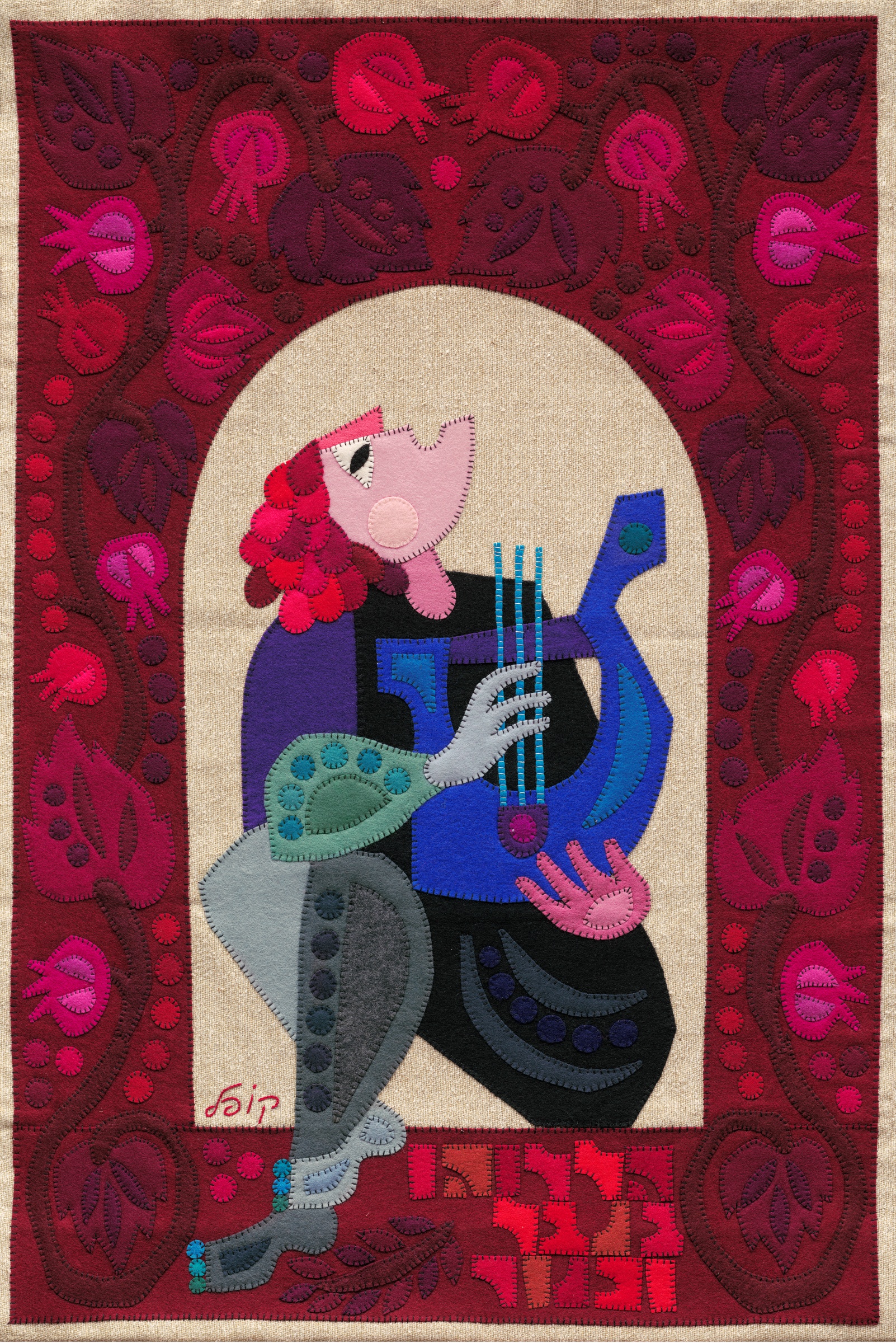
In Praise God, Kopel Gurwin presents King David as a musician-poet absorbed in an act of praise. Seated within a tall, pale arch, the figure holds a blue lyre whose curved form anchors the center of the composition. David’s upward-tilting head and open gesture suggest attentiveness, song, and spiritual elevation, transforming the act of music-making into an image of devotion.
The figure is enclosed by a richly ornamented field of deep crimson and burgundy, animated by stylized pomegranates, leaves, and scrolling vegetal forms. This surrounding border creates a ceremonial framework for the central image, while intensifying its visual presence through contrast. Gurwin’s color structure is especially striking here: the saturated reds of the frame set off the cool blues, greys, and violets of the musician and instrument, allowing the composition to feel at once jubilant and composed.
At the base of the image, the biblical verse is inscribed in Gurwin’s distinctive Hebrew letterforms, becoming part of the work’s ornamental rhythm rather than a separate caption. The lettering functions as both text and image, grounding the scene in scripture while reinforcing the handcrafted character of the composition. The visible stitching, sharply cut felt shapes, and layered construction contribute to the work’s tactile vitality and sense of deliberate craft.
The quoted verse, from Psalm 150, belongs to the concluding hymn of praise that calls for worship through music and exaltation. By centering David with his lyre and surrounding him with an atmosphere of abundance and radiance, Gurwin gives visual form to that call. The work becomes not only a representation of a biblical figure, but also a meditation on music as a vehicle for praise, memory, and sacred expression.
Praise Him with the psaltery and harp.
Interested in this artwork?
For questions about this work, reproduction rights, or fine art print availability, please get in touch.